Bedding · Nursery guide
A Safer Nursery Sleep Setup: What to Check in Bedding Materials
A nursery’s sleep environment depends on more than a mattress. Covers, pads, laundering routines, and the claims printed on a product label all deserve a close look. Here is how to weigh fiber content, fit, care, and certification—without letting reassuring language stand in for practical checks.
Preparing for a baby often involves a surprising amount of textile research. Cotton has varieties; wool has grades; “natural” seems to promise a whole philosophy. Somewhere among the swatches and product descriptions is a more immediate question: will this layer fit the crib mattress securely, and can it be cleaned as often as life with a baby requires? In a nursery, material choices matter, but they are only part of the picture. The sleep surface, bedding arrangement, fit, and routine of care matter too.
A useful starting point is to separate two concerns that shopping copy often blends together. One is the product’s composition and how it was made. The other is whether the product is appropriate for a baby’s sleep space and used as directed. A certification can help with the first question; it does not, by itself, answer the second. The goal is not to make a nursery sound pristine. It is to make decisions that are clear, practical, and consistent with current safe-sleep guidance.
Begin with the sleep surface, not the shopping language
For infants, safety guidance from organizations such as the American Academy of Pediatrics emphasizes a firm, flat sleep surface with a fitted sheet, and a clear sleep space. Recommendations can change and may vary by jurisdiction, so families should consult current advice from their pediatrician and public-health authorities. In general, the crib or bassinet should be used according to its manufacturer’s instructions, with an appropriately sized mattress and a fitted sheet designed for that mattress.
“Bedding” is a broad word, but a baby’s sleep area is not a place to layer in every item that might make an adult bed feel inviting. Loose blankets, pillows, quilts, comforters, stuffed toys, positioners, and other soft objects are generally not recommended in an infant’s sleep space. A decorative nursery may have many textures; the actual sleep surface should remain spare. A mattress pad, if used, should be compatible with the specific mattress and crib, lie flat, and not alter the firmness or fit of the sleep surface. When in doubt, follow the crib and mattress instructions and seek guidance from a qualified health professional.
That distinction is easy to lose amid descriptions of “cloud-soft” layers and “cocooning” comfort. Those phrases are designed to evoke the experience of adult bedding. They should not be taken as evidence that an item belongs in an infant’s sleep space. For nursery sleep, start with function and safety; consider fiber and finish within that framework.
Read the material declaration, not just the headline
A label that says “organic,” “eco,” “pure,” or “natural” can be a useful invitation to investigate. It is not a complete materials list. Look for a clear account of every major component: the fabric, fill or batting, backing, elastic, quilting thread, and any waterproof or protective layer. A product may have an organic cotton cover and a different material inside. That is not automatically a problem; it simply means the full construction is more informative than the headline.
Fiber content tells you what a textile is made from, while processing information can clarify how it was finished. Cotton, linen, wool, and plant-based fibers have different properties and care requirements. A “cotton” label does not necessarily say whether the fiber is certified organic, what dyes or finishes were used, or whether the product includes synthetic components. Conversely, the presence of a synthetic component does not automatically establish that a product is unsafe. It means a shopper should understand what it is, why it is there, and how the manufacturer recommends using and cleaning it.
Ask practical questions. Is the cover removable? Is the pad washable, or only spot-cleanable? Does the manufacturer specify a maximum temperature, a gentle cycle, or air-drying? Can it be dried completely without damaging its shape? These details have real consequences. A beautiful item that is difficult to clean may become a source of frustration when a simpler, washable option would serve the household better.
What certifications can—and cannot—tell you
Third-party certifications can make environmental and chemical claims easier to assess, especially when a company identifies the exact standard and the product or component it covers. They are not interchangeable, and no single label answers every question about a product’s safety, environmental impact, or suitability for infants. Read the scope carefully: does the certification apply to the cotton fiber, the finished fabric, the fill, the processing facility, or the whole product?
The Global Organic Textile Standard, commonly known as GOTS, addresses organic textile processing and includes criteria across relevant stages of production. A GOTS claim should be checked against the certificate or other documentation available from the seller or certifying body. A product description that merely says “GOTS-approved” without identifying what is certified can leave important questions unanswered. Ask whether the finished item is certified, or whether a particular material or supplier is covered.
Other labels may focus on a different part of the story, such as restrictions on certain substances in tested materials, responsible forestry for wood products, or sourcing and production practices. The name of a label is only the beginning. Check what it tests or verifies, which version of the standard is being used, and whether the claim can be independently confirmed. A certification is best understood as evidence about a defined set of criteria—not a universal guarantee that a product is risk-free or appropriate for every use.
Be equally attentive to claims that sound scientific but offer no detail. “Chemical-free” is not a meaningful literal description of a textile: all materials are made of chemicals. More useful language identifies the substances or processes the manufacturer has intentionally excluded, and explains how that claim is substantiated. Clear documentation is more valuable than a string of comforting adjectives.
Fit is a safety detail, not a finishing touch
Even a well-made sheet can be unsuitable if it does not fit the mattress. Check the mattress dimensions and the product’s stated dimensions, including its depth. Confirm that the fitted sheet is intended for the particular mattress type and that its corners stay secure. A sheet that rides up, bunches, or pulls away from the mattress needs attention; do not assume that a generous elastic edge will solve a mismatch.
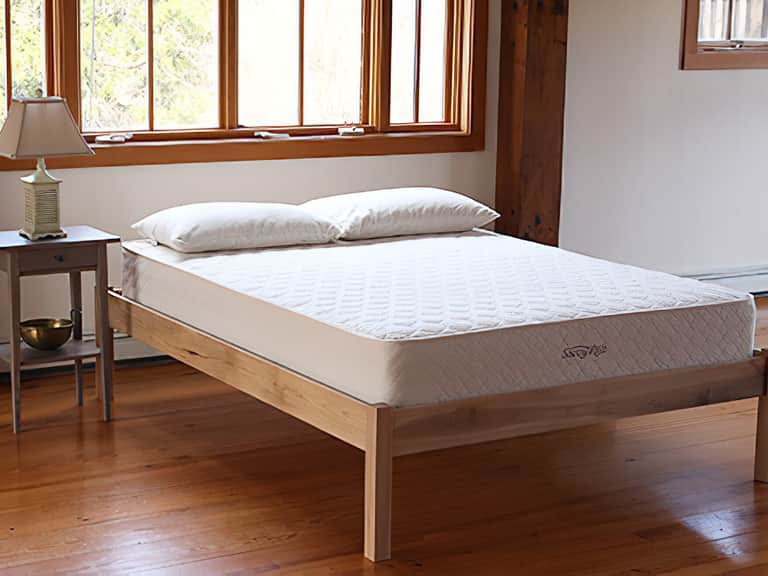
The same scrutiny applies to pads. Confirm that the pad is designed for a crib mattress rather than adapting a larger product or folding excess material underneath. A layer should not create gaps, folds, or an unstable surface. If a mattress pad is used, check that the mattress manufacturer allows it and that it does not compromise the fitted sheet’s secure fit. Avoid products marketed as positioning aids or inclined sleep devices unless a clinician and current safety guidance specifically support their use; do not improvise with towels, wedges, or rolled blankets.
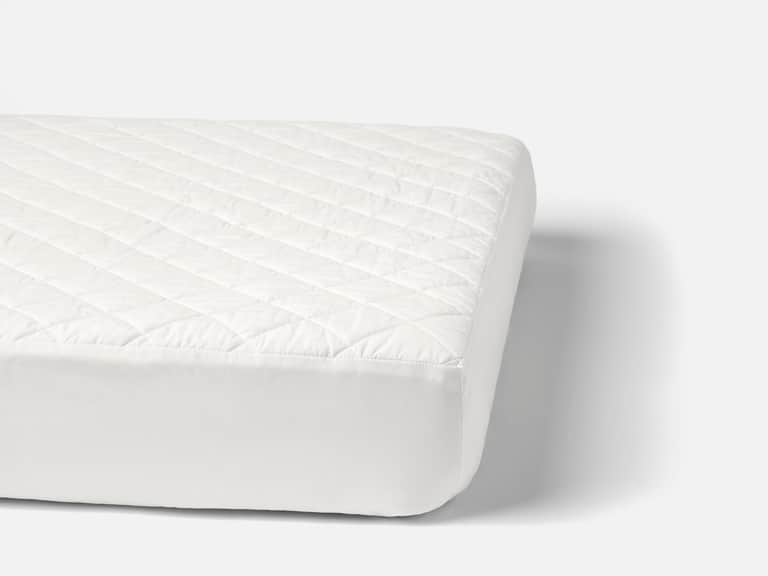
As an example of the information a careful shopper can look for, the Organic Crib Mattress Pad is described as having an organic cotton construction, a percale covering, a quilted design, and a stated care routine. It is also identified as GOTS certified. Those details give a buyer concrete points to verify: the product dimensions, the scope of the certification, the washing instructions, and compatibility with the intended mattress. A listing is a starting point for that check, not a substitute for reading the product label and the crib and mattress guidance.
Washing instructions belong in the buying decision
A nursery textile is not merely a material sample; it is something that will be used, soiled, washed, dried, and used again. Before buying, read the care label rather than assuming that “natural” means machine washable. Some covers can be laundered while their fillings cannot. Wool, latex, quilted cotton, and blends may require different treatment. A product that shrinks or loses shape in ordinary care can become difficult to fit correctly.
Wash new bedding according to its label before first use when the manufacturer recommends it, and use a detergent suitable for the household and the fabric. There is rarely a reason to add fragranced boosters or fabric softeners simply because they are marketed for babies. If a child has a diagnosed allergy or sensitive skin, a pediatrician or allergist can help families decide which products and routines are appropriate. Do not treat the word “hypoallergenic” as a promise that no person will react; it is not a guarantee of individual tolerance.
Dry items thoroughly and inspect them after washing. Check for stretched elastic, loose threads, broken seams, clumping, or a changed shape. Replace a sheet or pad that no longer stays flat and secure. Care instructions are not just housekeeping fine print: they help preserve the qualities that made a product appropriate in the first place.
Natural fibers are choices, not magic words
Families drawn to natural fibers may appreciate cotton for its familiar feel and broad availability, linen for its distinct texture, or wool for its insulating qualities in products designed for appropriate uses. But there is no single fiber that makes a nursery safer by definition. Fiber selection should be considered alongside construction, finish, fit, laundering, and the intended use of the item.
Natural materials also have their own trade-offs. Cotton can shrink if care instructions are ignored. Linen tends to wrinkle. Wool may be harder to wash than a removable cotton cover. A product made from a renewable source can still have a complex supply chain or require careful maintenance. “Natural” describes an origin or material category; it does not tell the whole story about durability, processing, or performance.
It is sensible to consider a family’s priorities—such as breathable fabric, traceable sourcing, or fewer added finishes—without turning a purchase into a referendum on parenting. The best bedding choice is one that meets the product’s intended use, fits the sleep surface properly, can be cared for as directed, and aligns with what the household can maintain.
A calm checklist for comparing nursery bedding
Before bringing a textile into a nursery, take a moment with the listing, the product tag, and the manufacturer’s instructions. A concise review can prevent the most common misunderstandings:
- Identify the item’s role. Is it a fitted sheet, a protective pad, or an accessory that should not be used in the infant’s sleep space?
- Check the complete composition. Look for the fiber content of the cover, fill, backing, and other significant components.
- Verify the claim. Find the exact certification, its scope, and documentation that supports the product’s wording.
- Measure for fit. Compare product dimensions with the mattress and follow the mattress and crib manufacturers’ instructions.
- Read the care label. Confirm how the item can be washed and dried, and whether its shape and fit will be maintained.
- Keep the sleep space clear. Follow current infant safe-sleep recommendations and avoid adding loose or unapproved items.
- Ask when details are missing. Request written answers from the manufacturer or retailer rather than relying on an ambiguous product title.
The quieter kind of preparation
Nursery shopping can invite the fantasy that every decision must be optimized before the baby arrives. But a useful setup is not measured by the number of certifications on its labels or by how many carefully chosen layers fit in a crib. It is measured by whether the essentials are clear: an appropriate, firm, flat sleep surface; a fitted sheet that stays in place; products used as intended; and care instructions a tired household can realistically follow.
Materials still matter. Transparent fiber information helps families compare options; credible certification can add useful context; and thoughtful care can extend the life of a textile. Yet no marketing phrase replaces fit or current safety guidance. When the product description is precise, the label is understandable, and the sleep space remains simple, the decision becomes less mysterious. The result is not a perfect nursery. It is a more considered one.
Frequently asked questions
Does organic automatically mean safer for a baby?
No label can make that promise on its own. Organic claims refer to defined production criteria, and certifications vary in what they cover. Check the product’s composition, certification scope, fit, intended use, and care instructions. For the sleep space itself, follow current infant safe-sleep guidance.
Can I use a mattress pad in a crib?
Use only a product that is appropriate for the crib mattress, permitted by the relevant manufacturers, and fitted so it lies flat without creating gaps or changing the sleep surface. Consult current public-health guidance and your pediatrician if you are unsure. Do not add loose or improvised layers.
What should a bedding certification tell me?
It should identify a defined standard and the material, process, or product covered. Check the certifier’s documentation and avoid assuming that one certification addresses every issue, including infant sleep safety, durability, or individual allergies.
How can I tell whether a product is easy to care for?
Read the care label before purchase. Note whether the whole item can be washed or only its cover, what water temperature is permitted, and how it should be dried. After laundering, inspect the item to make sure it remains intact and fits securely.